
LiFePO4 vs Lead-Acid Battery: Which Is Better for Solar Storage in 2026?
A data-driven comparison of LiFePO4 and lead-acid batteries for solar energy storage, covering cycle life, total cost of ownership, safety, and real-world performance to help you make the right choice.
If you are designing a solar energy storage system in 2026, the battery chemistry you choose will determine your long-term costs, reliability, and safety. The two most common options are LiFePO4 (lithium iron phosphate) and traditional lead-acid batteries. While lead-acid has been the default choice for decades, LiFePO4 technology has matured dramatically, and the economics now overwhelmingly favor lithium in most solar storage applications. This article breaks down every critical dimension with real numbers so you can make a confident decision.
Cycle life is the single most important differentiator. A quality LiFePO4 battery rated at 6,000+ cycles at 80% depth of discharge (DoD) will deliver 16+ years of daily use before capacity drops below 80% of its original rating. In contrast, a deep-cycle lead-acid battery typically provides only 500 to 1,000 cycles at 50% DoD, translating to roughly 2 to 4 years of service in a daily-cycling solar system. Over a 15-year project lifetime, you would need to replace a lead-acid battery bank 4 to 7 times, while a single LiFePO4 installation lasts the entire period.
Depth of discharge (DoD) is where the practical usable capacity gap becomes stark. LiFePO4 batteries can safely discharge to 80-95% of their rated capacity without meaningful degradation. A 12.8V 100Ah LiFePO4 battery (approximately 1.28 kWh) gives you a full 100Ah of usable capacity at 80% DoD. Lead-acid batteries, by contrast, should never be discharged below 50% to avoid sulfation damage. A 100Ah lead-acid battery therefore provides only about 50Ah of usable capacity, meaning you must buy twice the rated capacity to get the same usable energy as a lithium unit.
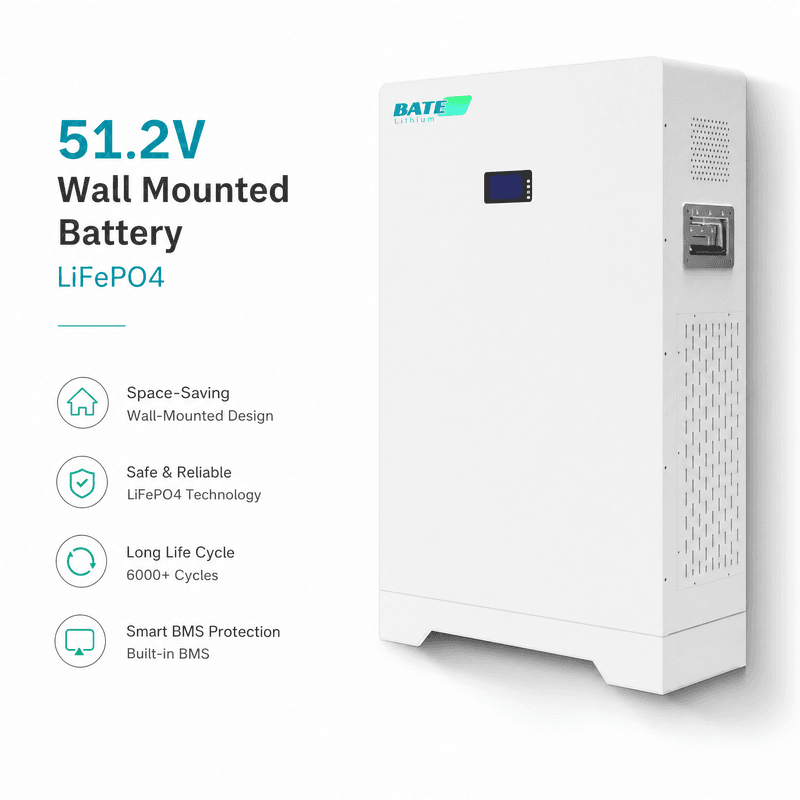
Weight and volume matter enormously for residential installations where space is limited. A typical 12V 100Ah LiFePO4 battery weighs approximately 11-14 kg, while an equivalent 12V 100Ah lead-acid battery weighs 27-32 kg. LiFePO4 is roughly 60% lighter. In terms of energy density, lithium iron phosphate delivers about 150-200 Wh/kg compared to 30-50 Wh/kg for lead-acid. For a wall-mounted residential system like the BATE Lithium 51.2V series, this means the entire 5.12 kWh battery pack can be mounted on a standard wall without structural reinforcement, something impossible with an equivalent lead-acid bank.
Maintenance requirements represent a hidden ongoing cost of lead-acid systems. Flooded lead-acid batteries require regular water top-ups, terminal cleaning to prevent corrosion, and periodic equalization charges to prevent sulfation. You must also keep them in a ventilated area due to hydrogen gas emission during charging. LiFePO4 batteries are completely sealed, maintenance-free, and emit no gases during normal operation. The built-in Battery Management System (BMS) automatically handles cell balancing, overcharge protection, over-discharge cutoff, and temperature monitoring, requiring zero user intervention.
Now let us examine the total cost of ownership (TCO) over a 10-year period with real calculations. Consider a solar system that needs 5 kWh of usable daily storage. For lead-acid at 50% DoD, you need a 10 kWh rated bank (roughly eight 12V 200Ah batteries at approximately $250 each, totaling $2,000). With 500-1,000 cycles, you would replace this bank 3 to 5 times over 10 years, bringing the battery replacement cost to $6,000-$10,000. Add maintenance costs of roughly $100-$200 per year for water, cleaning, and equalization charging, totaling $1,000-$2,000. The 10-year TCO for lead-acid is $7,000-$12,000. For LiFePO4, a BATE Lithium 51.2V 5.12 kWh wall-mounted system costs approximately $1,500-$2,000 upfront. With 6,000+ cycles, it lasts the full 10 years with no replacements and zero maintenance. The 10-year TCO is simply the initial purchase price of $1,500-$2,000. The lithium option saves $5,000-$10,000 over a decade.
Safety is a legitimate concern with any battery technology, and both chemistries have distinct profiles. LiFePO4 is the safest lithium chemistry available, with a thermal runaway onset temperature of approximately 270 degrees Celsius, far higher than other lithium chemistries like NMC (around 150 degrees Celsius). The olivine crystal structure of LiFePO4 makes it extremely stable and resistant to thermal propagation. Lead-acid batteries, while not prone to thermal runaway, emit hydrogen gas during charging, which creates an explosion hazard in poorly ventilated spaces. They also contain sulfuric acid, which poses chemical burn and environmental contamination risks if the casing cracks or leaks.
Temperature performance affects real-world energy harvest, especially in tropical and subtropical climates. LiFePO4 batteries maintain excellent performance from 0 to 45 degrees Celsius with minimal capacity loss, and the internal BMS provides low-temperature charging cutoff to prevent lithium plating. Lead-acid batteries suffer significant capacity reduction in cold weather, losing up to 50% of rated capacity at freezing temperatures. In hot conditions above 35 degrees Celsius, every 10 degrees Celsius rise above the 25 degrees Celsius baseline halves the lifespan of a lead-acid battery, a critical disadvantage in Southeast Asian and Middle Eastern markets.
Environmental impact and end-of-life recycling are increasingly important considerations. LiFePO4 batteries contain no cobalt, no nickel, and no toxic heavy metals. The iron and phosphate in the cathode are abundant, non-toxic elements. At end of life, LiFePO4 cells can be repurposed for second-life applications (such as lower-demand backup storage) before recycling, and the materials are recoverable through established processes. Lead-acid batteries, while having a well-established recycling infrastructure with a 99% recycling rate in developed countries, contain lead, a cumulative neurotoxin. Mining, smelting, and recycling lead all pose serious health and environmental risks, and accidental spills during recycling contaminate soil and groundwater.
There are still scenarios where lead-acid makes sense. If your budget is extremely constrained and you need the lowest possible upfront cost, lead-acid batteries remain cheaper per unit of rated capacity at the point of purchase. They are also widely available in virtually every market worldwide, including remote areas where lithium distribution networks have not yet been established. For very infrequent-use applications like emergency backup systems that rarely cycle, the cycle life advantage of lithium matters less. However, for any solar storage system that cycles daily, the economics, performance, and safety advantages of LiFePO4 are so overwhelming that choosing lead-acid is difficult to justify.
The verdict for 2026 is clear: LiFePO4 is the superior choice for solar energy storage in virtually every scenario that involves regular daily cycling. The BATE Lithium product line covers the full range of residential and commercial needs, from the 12.8V 100Ah battery at just $89-$109 for small off-grid systems, to the 51.2V wall-mounted residential ESS series (5.12 kWh to 10.24 kWh), all the way up to the 16 kWh and 20.48 kWh floor-standing systems for larger homes. With 6,000+ cycle life, zero maintenance, 80% usable depth of discharge, and a built-in smart BMS, BATE Lithium LiFePO4 batteries deliver the lowest total cost of ownership and the highest reliability for your solar investment. Contact us via Zalo at +8613612911335 or email Julian@batelithium.com for a customized system recommendation.
Need help choosing a system?
Send your load profile and backup needs to BATE Lithium for a suitable battery and inverter recommendation.
Contact Sales