
How to Size a Home Battery Storage System: Complete Guide for 2026
Learn step-by-step how to calculate the right battery capacity and inverter size for your home, with real examples for apartments, medium houses, and large villas, plus BATE Lithium product recommendations.
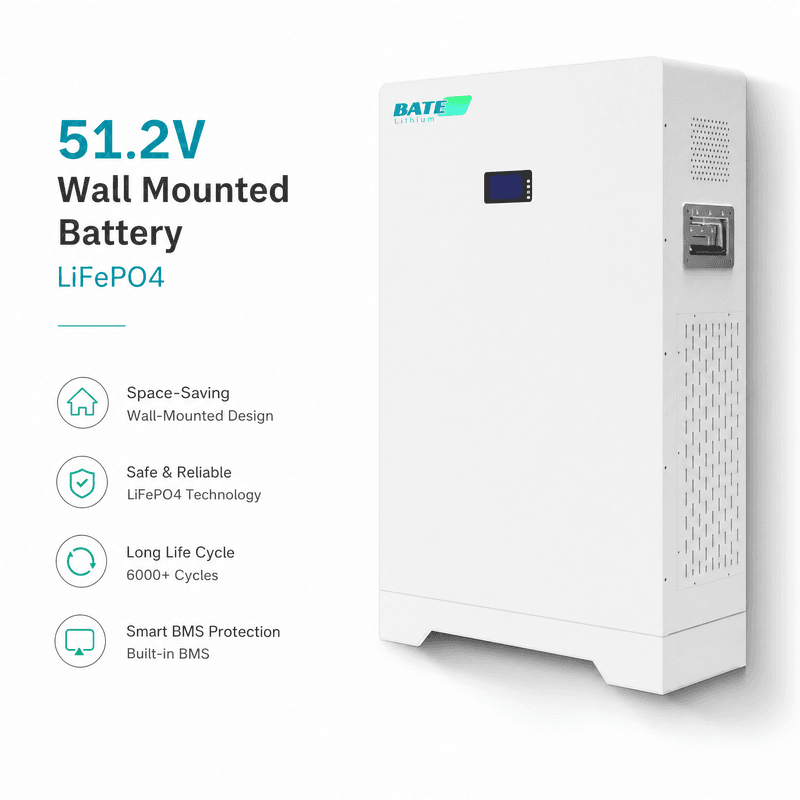
Sizing a home battery storage system correctly is the single most important decision that determines whether your investment pays off or wastes money. Undersize the system and you face frequent power shortages during outages or miss out on solar self-consumption savings. Oversize it and you tie up capital in unused capacity that may take decades to recoup. This guide walks you through the exact calculation methodology used by professional solar installers, with real-world examples for three common home profiles and specific BATE Lithium product recommendations for each.
The first step is calculating your daily energy consumption in kilowatt-hours (kWh). Review your electricity bills for the past 6 to 12 months and find your average daily usage. For example, if your monthly bill shows 450 kWh, your daily consumption is 450 divided by 30, which equals 15 kWh per day. It is critical to understand the difference between kW (kilowatts, a measure of power or instantaneous demand) and kWh (kilowatt-hours, a measure of energy consumed over time). A 1.5 kW air conditioner running for 8 hours consumes 12 kWh of energy. Your battery must store enough kWh to cover the hours you need backup or self-consumption, while your inverter must be rated in kW to handle the simultaneous power draw of all running appliances.
Next, determine your primary goal: is the battery for backup power during grid outages, for maximizing solar self-consumption, or for both? For backup-only sizing, you need to decide how many hours of autonomy you want. A typical household essential load (refrigerator, lights, fans, router, and phone charging) draws about 1 to 2 kW continuously. For 8 hours of backup, you need 8 to 16 kWh of usable battery capacity. For solar self-consumption, you need to match the battery capacity to the excess solar energy your panels produce during the day that would otherwise be exported to the grid. A 5 kW solar system in a tropical climate typically produces 20 to 25 kWh per day, of which a household might use 10 to 15 kWh directly and export 5 to 15 kWh. A battery sized to absorb that excess (typically 5 to 10 kWh) maximizes your self-consumption rate from around 40% to over 80%.
Battery capacity calculations must account for depth of discharge (DoD) and system efficiency. If you need 10 kWh of usable energy and your battery supports 90% DoD (like BATE Lithium LiFePO4 systems), the rated capacity needed is 10 kWh divided by 0.9, which equals approximately 11.1 kWh. Factor in inverter and wiring losses of about 5-10%, so the actual battery capacity should be around 12 kWh. For lead-acid batteries limited to 50% DoD, you would need 20 kWh of rated capacity for the same 10 kWh of usable energy, which is why LiFePO4 systems require roughly half the physical battery capacity.
Inverter sizing is the other critical calculation. Your inverter must handle the peak simultaneous load of all appliances that could run at the same time. List every appliance and its wattage: a refrigerator (150W running, 800W surge), air conditioner (1,500W), water heater (2,000W), microwave (1,000W), lights (200W total), and so on. If the maximum simultaneous draw is 5 kW, you need at minimum a 5 kW inverter, though a 6 kW unit provides a comfortable safety margin for surge currents. BATE Lithium offers NKH off-grid hybrid inverters from 1.2 kW to 12 kW and ES hybrid inverters from 6 kW to 12 kW, all natively compatible with the 51.2V battery platform.
You must also plan for future loads that will increase your energy consumption. Electric vehicle (EV) charging adds 7 to 22 kWh per charging session depending on the charger level. A heat pump for water heating or space conditioning adds 2 to 5 kWh per day. If you plan to purchase an EV within the next 3 to 5 years, oversizing your battery by 5 to 10 kWh now is far more cost-effective than upgrading the entire system later. Similarly, if you plan to add more solar panels, ensure your battery and inverter can accommodate the additional generation capacity.
The 51.2V system architecture offers significant advantages over traditional 12V or 48V systems for home energy storage. Higher voltage means lower current for the same power, which reduces resistive losses in cables and allows the use of thinner, less expensive wiring. A 5 kW load at 51.2V draws approximately 98 amps, compared to 417 amps at 12V. Lower current also means less heat generation, higher round-trip efficiency (typically 95-97% for 51.2V systems versus 90-93% for 48V), and better compatibility with high-power hybrid inverters. The BATE Lithium 51.2V residential ESS series is specifically designed around this optimal voltage platform.
For a small apartment consuming 8 to 12 kWh per day with a 3 kW solar system, the recommended setup is a single BATE Lithium 51.2V 5.12 kWh wall-mounted residential ESS unit paired with a 3-5 kW NKH or ES hybrid inverter. This provides approximately 4.6 kWh of usable energy (at 90% DoD), enough to cover evening essential loads and increase solar self-consumption from 40% to approximately 70%. The wall-mounted form factor requires no floor space and can be installed in a utility closet or garage. The total system cost is highly accessible, with the battery unit starting in the $1,500 to $2,000 range.
For a medium-sized house consuming 15 to 25 kWh per day with a 5 to 8 kW solar system, the recommended configuration is two parallel BATE Lithium 51.2V wall-mounted units (totaling 10.24 kWh of rated capacity) paired with a 6-8 kW ES hybrid inverter. This delivers approximately 9.2 kWh of usable storage, sufficient for 6 to 8 hours of essential backup during outages and raising solar self-consumption to over 85%. The modular design allows you to start with one unit and add a second later as your budget or energy needs grow. For homes with higher air conditioning usage common in tropical climates, consider upgrading to the 16 kWh floor-standing battery for extended autonomy.
For a large villa consuming 30 to 50 kWh per day with a 10 kW or larger solar system, the ideal setup is the BATE Lithium 20.48 kWh floor-standing battery paired with a 10-12 kW ES hybrid inverter, or multiple 51.2V wall-mounted units in parallel for a total of 20 to 30 kWh. This capacity covers full-house backup for 12+ hours, supports EV charging integration, and achieves near-complete solar self-consumption. For villas that require even greater capacity or three-phase power, the BATE Lithium high-voltage residential ESS series can be configured in stacked modules up to 10.24 kWh per stack, with multiple stacks operating in parallel.
Common sizing mistakes to avoid include: ignoring surge currents when sizing the inverter (a refrigerator compressor can draw 5 to 8 times its running wattage at startup), failing to account for battery aging and capacity degradation over time (always add a 10-20% buffer), sizing the battery based on peak load rather than energy consumption (a 3 kW load for 2 hours needs 6 kWh, not 3 kWh), and overlooking the importance of matching the inverter communication protocol with the battery BMS for optimal performance and safety. BATE Lithium batteries feature built-in CAN/RS485 communication with all major inverter brands.
While this guide provides a solid framework for preliminary sizing, every home has unique characteristics that affect the optimal configuration, including local climate, roof orientation, electricity tariff structure, and specific appliance profiles. We strongly recommend consulting with a qualified solar installer or contacting BATE Lithium directly for a personalized system design. Our engineering team can analyze your electricity bills, solar generation data, and load profile to recommend the exact battery capacity, inverter model, and system topology for your situation. Reach out via Zalo at +8613612911335 or email Julian@batelithium.com for a free consultation and customized proposal.
Need help choosing a system?
Send your load profile and backup needs to BATE Lithium for a suitable battery and inverter recommendation.
Contact Sales