
Commercial & Industrial BESS: A Complete Guide for Building Owners and Facility Managers
Everything building owners and facility managers need to know about commercial battery energy storage systems, from peak shaving economics and ROI calculations to system architecture and BATE Lithium product selection.
Commercial and industrial (C&I) buildings face a perfect storm of rising electricity costs, increasing demand charges, grid instability, and growing pressure to reduce carbon footprints. A Battery Energy Storage System (BESS) addresses all four challenges simultaneously, transforming your building from a passive electricity consumer into an active energy manager. This guide explains why C&I buildings need BESS, how the economics work, what system architectures are available, and how to select the right BATE Lithium products for your facility, whether you operate a small office building or a large manufacturing plant.
Peak shaving is the most immediate and quantifiable financial benefit of a C&I BESS. Most commercial electricity tariffs have two components: energy charges (per kWh consumed) and demand charges (per kW of peak demand during a billing period, typically 15 or 30 minutes). In many markets, demand charges can account for 30-50% of the total electricity bill. A BESS discharges during your facility peak demand periods, effectively "shaving" the peak and reducing your demand charge. For example, if your facility peaks at 500 kW and your demand charge is $15 per kW, your monthly demand charge is $7,500. A 200 kW / 400 kWh BESS that reduces your peak by 200 kW saves $3,000 per month, or $36,000 per year, on demand charges alone.
Demand charge reduction works in tandem with peak shaving and often provides even greater savings. While peak shaving targets your absolute highest demand interval, demand charge management flattens your entire demand profile throughout the billing period. The BESS charges during off-peak hours when electricity is cheap (often 40-60% less than peak rates) and discharges during all on-peak hours, not just the single highest peak. This arbitrage between off-peak charging and on-peak discharging generates additional savings on energy charges. In combination, peak shaving and demand charge management typically deliver a combined annual savings of 15-30% on total electricity costs for C&I facilities.
Backup power for critical loads is another compelling value proposition, particularly for facilities where grid outages cause production losses, data loss, or safety risks. Manufacturing plants lose an average of $5,000 to $50,000 per hour of unplanned downtime depending on the industry. Data centers, hospitals, and cold chain logistics facilities face even higher costs. A BESS provides seamless, zero-transfer-time backup that is faster than diesel generators (which require 10-30 seconds to start). For extended backup, the BESS can be paired with a diesel or natural gas generator, with the battery providing instant bridge power until the generator reaches full output, and the generator sustaining the load for hours or days.
Solar self-consumption maximization is increasingly important as more C&I buildings install rooftop or carport solar PV systems. Without storage, a typical commercial building exports 50-70% of its solar generation to the grid at low feed-in tariffs (often $0.03-$0.05 per kWh) while buying electricity back at retail rates ($0.10-$0.25 per kWh) during non-solar hours. A BESS captures excess midday solar generation and shifts it to evening and nighttime use, effectively turning a low-value export into high-value self-consumption. For a building with a 200 kW solar array, a 200 kWh BESS can increase solar self-consumption from 30% to over 80%, generating an additional $10,000 to $30,000 in annual savings depending on local electricity rates.
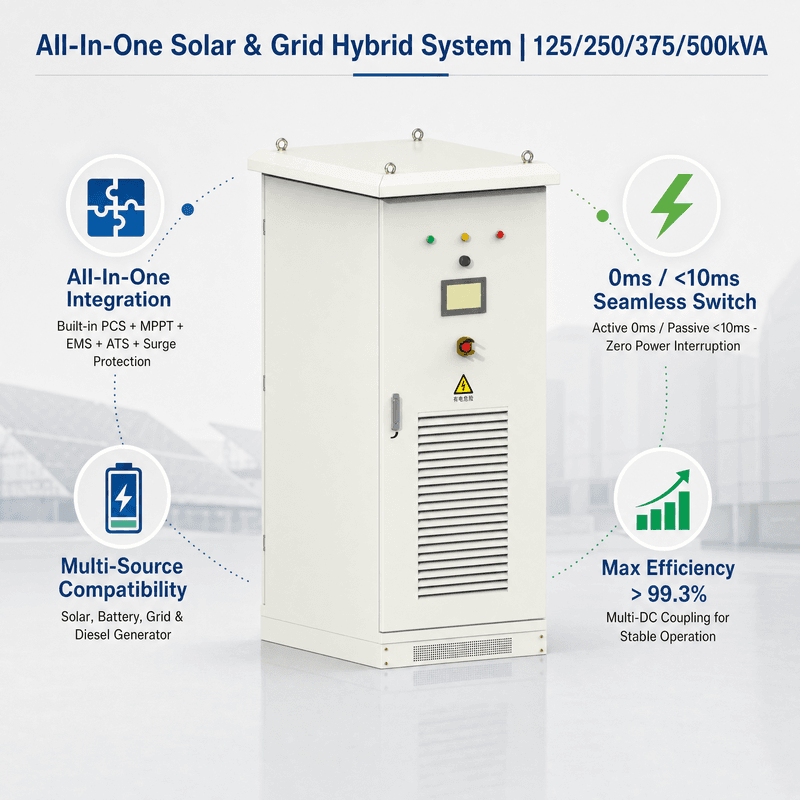
Microgrid capability represents the most advanced application of C&I BESS, allowing your facility to operate independently from the grid during extended outages or to participate in grid services for additional revenue. A microgrid combines solar PV, BESS, backup generators, and smart controls into an integrated system that can island from the grid and maintain power to critical loads. BATE Lithium offers the HCPS micro-grid PCS (100-125 kW) and the HAG2 all-in-one system (125-500 kVA) specifically designed for microgrid applications. These systems provide seamless grid-connected and islanded operation, black-start capability, and intelligent load shedding to maximize backup duration.
System architecture selection between DC coupling and AC coupling is a fundamental design decision. In a DC-coupled system, the battery connects directly to the solar PV DC bus through a hybrid charge controller, allowing solar energy to charge the battery without a second DC-to-AC conversion. This achieves higher round-trip efficiency (typically 92-95%) and is ideal for new installations where solar and storage are designed together. In an AC-coupled system, the battery connects to the AC side through a bidirectional inverter (PCS), which is simpler to retrofit to existing solar installations and provides more flexible placement of the battery relative to the solar array. BATE Lithium supports both architectures with its range of PCS products.
Selecting the right Power Conversion System (PCS) is critical to system performance. For facilities with loads between 15 and 60 kW, the BATE Lithium HBPS PCS series offers modular, high-efficiency bidirectional conversion with built-in grid support functions including power factor correction and harmonic filtering. For larger facilities with loads between 100 and 125 kW per unit, the HCPS micro-grid PCS provides higher power density, microgrid-ready architecture with seamless islanding capability, and parallel operation for systems up to megawatt scale. For the most demanding applications requiring integrated transformer and switchgear, the HAG2 all-in-one system (125-500 kVA) combines the PCS, battery interface, transformer, and protection systems in a single factory-tested enclosure, dramatically reducing on-site installation time and commissioning complexity.
Typical project sizes and ROI timelines vary by facility type and electricity cost structure. A small office building with 50-100 kW peak demand might install a 50 kW / 100 kWh system for $40,000 to $80,000, achieving simple payback in 3 to 5 years through demand charge reduction and solar self-consumption. A medium manufacturing plant with 200-500 kW peak demand might deploy a 200 kW / 500 kWh system for $150,000 to $300,000, with payback in 3 to 6 years when combining peak shaving, demand management, and solar integration. Large industrial facilities with multi-megawatt demand can achieve economies of scale with systems of 1 MWh or more, often reaching payback in 2 to 4 years. With BATE Lithium BESS all-in-one systems ranging from 30 kWh to 500 kWh, there is a right-sized solution for every facility scale.
Installation requirements for C&I BESS include adequate space (indoor or outdoor rated enclosures are available), proper ventilation for thermal management, electrical interconnection to the main distribution panel or a dedicated bus section, and compliance with local electrical codes and fire safety regulations. The BATE Lithium BESS all-in-one systems are factory-assembled and pre-tested, arriving on-site as a single integrated unit that requires only electrical connection and commissioning. This plug-and-play approach reduces installation time from weeks to days. For outdoor installations, the IP55-rated enclosure protects against dust and water ingress, and the integrated HVAC system maintains optimal battery temperature in ambient conditions from -20 to 50 degrees Celsius.
Maintenance of modern LiFePO4 BESS is minimal compared to traditional backup systems. The battery modules require no scheduled maintenance beyond periodic visual inspection and firmware updates. The BMS continuously monitors every cell voltage, temperature, and current, automatically balancing cells and alerting operators to any anomalies through the remote monitoring platform. Inverter and PCS maintenance is limited to annual inspection of electrical connections and cooling system filters. Compared to diesel generators that require monthly run tests, oil changes, filter replacements, and fuel management, a BESS reduces annual maintenance costs by 70-90% while providing faster, cleaner, and quieter backup power.
Getting started with BATE Lithium is straightforward. Send your monthly electricity bills, facility load profile, and any existing solar system details to our engineering team via email at Julian@batelithium.com or Zalo at +8613612911335. We will provide a free detailed ROI analysis including projected monthly savings, payback period, and 20-year lifetime value. Our proposal will specify the exact system configuration, including battery capacity, PCS model, and system topology optimized for your facility. BATE Lithium supports projects from initial consultation through system design, manufacturing, shipping, commissioning support, and lifetime technical service, making us your single-source partner for commercial and industrial energy storage.
Need help choosing a system?
Send your load profile and backup needs to BATE Lithium for a suitable battery and inverter recommendation.
Contact Sales